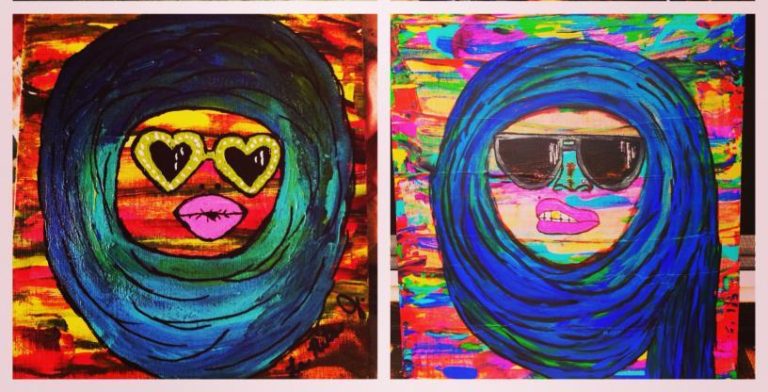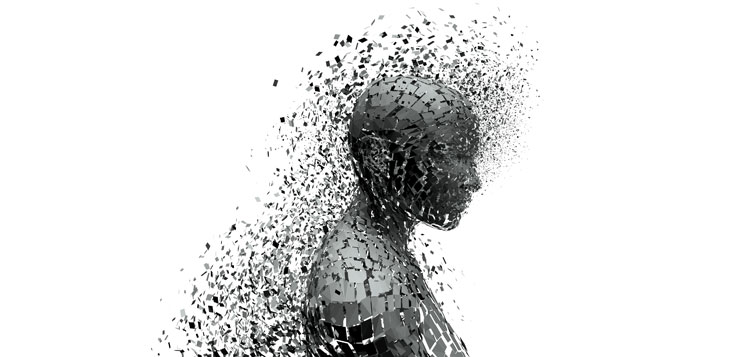

I stumbled across conscious connected breathwork about four years ago, when I desperately needed some selfcare and I decided to book a day retreat for myself. Not knowing what breathwork was exactly, I was open to finding out what this practice had to offer me. I was curious about how breathwork could meet me in processing my racial trauma and what my body remembers.
In a group of the white majority, I felt conscious of myself being the only person of colour. I was nervous, anxious and slightly frightened – what had I let myself in for? How could I spend the day feeling alone and feeling invisible: a feeling that is familiar to me from when I was a young child in all white spaces. As the introductions began, I noticed no one was sitting next to me – I was alone. There was a void, an emptiness which touched on a historical hurt that I had experienced through being excluded – the covert racism which shreds the soul piece by piece. A few minutes in, someone opened the door, a late arrival. I looked at the door and to my relief, another woman of colour walked in and sat next to me – what a sigh of relief, my body relaxed and I was able to breathe.
As the breathwork was introduced, it was explained that a range of emotions might arise – from tears, to screams to laughter. I listened attentively curious about what might emerge for me and feeling slightly self-conscious of how I might express my emotions and what my body might reveal. I laid down ready for the practice to start, slightly apprehensive but open to what might be possible.
We were guided by the facilitator to breathe in a particular way- something that was new to me. I continued to breathe with my eyes closed. My body felt tight, and I remember trying hard to get the breath right. I continued to breathe. My body felt stiff- I kept breathing, waiting for something to happen, wondering if I was doing it wrong. Nothing seemed to shift.
I stayed there, in that quiet frustration, noticing others around me drop into something I couldn’t seem to access. I could hear sounds, noises, tears, grunts. What was I doing wrong? Then I felt the facilitator kneeling beside me. In a soft voice, she asked if she could hold my hand. I said yes. Still, nothing. Then she asked me to make eye contact with her. As soon as I did, something broke open. The tears came suddenly and fully. It felt like years of holding – pain, grief, something unnamed—began to move. That was my first experience of breathwork. I began to understand how breathwork and racial trauma are connected in my body.
Breathwork and Racial Trauma in the Body
Four years on, I’ve returned to this practice many times, often with the same facilitator. Feeling safe with her was essential. Each workshop would begin slowly – building connection within the group, moving our bodies, becoming reacquainted with ourselves and each other – before moving into the breath itself. That sense of relational safety felt just as important as the practice.
Each time, something different has emerged. I’ve connected with grief that feels older than me, something carried across generations. I’ve felt the imprint of violation in my body, both as a woman and as a woman of colour. I’ve encountered places of neglect and abandonment within myself – ways I had learned to disconnect, to survive. These weren’t always easy experiences, but they felt real. And something in that realness allowed for movement and integration.
At the same time, one thing became increasingly clear to me in these spaces: I was often the only woman of colour, or one of very few. There was a subtle but persistent sense of being outside of the group. At times, I noticed myself holding back, not fully dropping into the work. My body didn’t always feel safe enough to access the depth of what I carry – particularly the impact of my racial trauma. There was a quiet vigilance, a sense of needing to monitor, to stay slightly apart.
This made me reflect on how deeply racialised experience lives in the body. As Resmaa Menakem writes, trauma is held somatically, and healing requires a sense of safety – or at least “safe enough” – within our nervous systems. For me, that safety is not just individual, but relational. It is shaped by who is in the room, whose experiences are mirrored, and whether my body recognises itself in the space around it.
In spaces where that resonance is missing, something important can remain out of reach. The parts of us shaped by racial harm can stay unspoken, unprocessed, still held.
In our book, Therapists Challenging Racism and Oppression: The Unheard Voices, each author shares experiences of racial harm – stories that are often silenced or minimised. Writing my own chapter was part of my healing. Speaking these experiences and having them witnessed in spaces that feel attuned and respectful, has allowed something to shift. It is an ongoing process of integration—of bringing back parts of myself that have had to stay hidden or protected.
This is what has led me to create a workshop called “Untold Stories of Racialised Experience: embodied healing and integration”, to offer a supportive and exploratory space to work with breathwork and racial trauma.
It is a space for people of colour to come together, to share and process experiences of racial harm, and to work with the body through breath. Not as a way to erase what has happened, but as a way to reduce the weight it holds in our bodies and our lives. To move some of what has been carried alone.
Because when we are able to be with these experiences – held, witnessed, and supported – something changes. There can be a little more space. A little less fear. A little more capacity to stand in the world without bracing against it.
If you are interested in exploring how breathwork might support you, you can click on this link for further information. Evolve Breath and Body
If you would like to book a space at my upcoming workshop where we work with breathwork and racial trauma, please click here Untold Stories of Racialised Experience: Embodied Healing and Integration.
To find out more about me click here